Riddles in the Dark
The riddle-game between Bilbo Baggins and Gollum, played in the absolute darkness beside a subterranean lake deep under the Misty Mountains, is the hinge upon which the entire adventure turns. It is here that Bilbo, lost and alone after being separated from the dwarves and Gandalf during their escape from the goblins, stumbles upon a small ring of cold metal on the tunnel floor—a discovery he makes almost without thinking, and whose significance he does not yet grasp. The game itself, a contest of wits with a wretched creature who has not spoken to another soul for ages, becomes the crucible in which Bilbo’s latent courage, quick thinking, and moral complexity are forged. By the time he emerges from the darkness, he is no longer the flustered hobbit who left Bag-End without a pocket-handkerchief; he has won a magic ring, learned to trust his own resourcefulness, and earned the enmity of a creature whose cry of "Thief, thief, thief! Baggins! We hates it, we hates it, we hates it for ever!" will echo through the rest of the story and beyond.
The Setting and the Creature
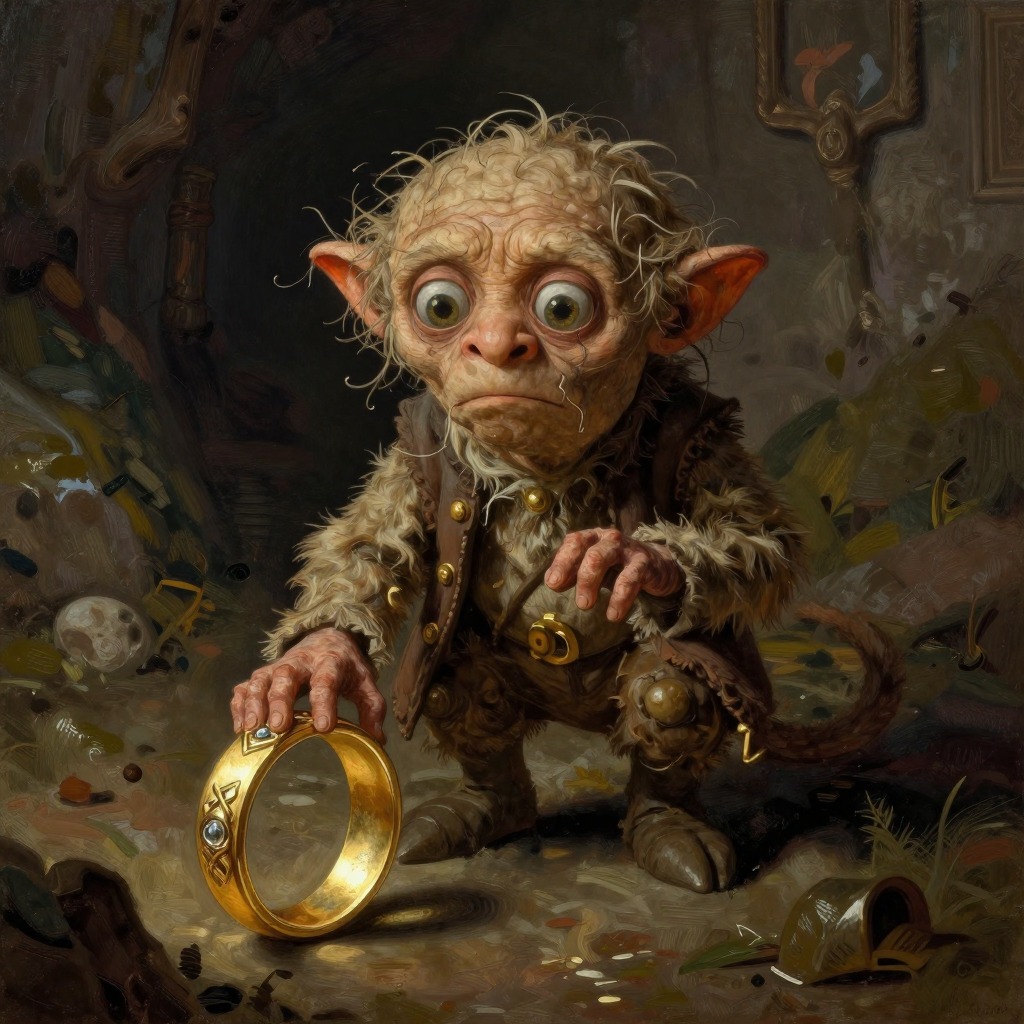
Bilbo awakens in a darkness so complete that he cannot tell whether his eyes are open or shut. He is alone, having been knocked unconscious when Dori, carrying him on his back during the flight from the goblins, was grabbed from behind and the hobbit rolled off into the blackness. Groping on all fours, he finds nothing but stone—until his hand meets a tiny ring of cold metal. He puts it in his pocket almost without thinking, not realizing it is a turning point in his career. The tunnel leads him steadily downward until he splashes into icy water, the edge of a deep, dark lake. Here, in the very roots of the mountain, lives Gollum, a small slimy creature with two big round pale eyes in his thin face. Gollum paddles about the lake in a little boat, catching blind fish with his long fingers, and occasionally throttling stray goblins who venture too near. He has lived here alone for so long that he talks to himself, always calling himself "my precious." When he sees Bilbo, he is not immediately hungry—only curious—and so he proposes a game of riddles, the only amusement he remembers from the long, long ago before he crept down into the dark.
The Riddle Contest
The game is played under a terrible stakes: if Gollum asks a riddle Bilbo cannot answer, Gollum will eat him; if Bilbo asks one Gollum cannot answer, Gollum must show him the way out. Gollum goes first, hissing out a riddle about a mountain: "What has roots as nobody sees, Is taller than trees, Up, up it goes, And yet never grows?" Bilbo answers easily, and the contest proceeds through a series of riddles that draw on both the natural world and the dark, forgotten corners of Gollum's memory. Bilbo asks about teeth on a red hill (chestnuts), and Gollum answers. Gollum asks about the wind, and Bilbo answers. Bilbo makes up a riddle on the spot about an eye in a blue face seeing an eye in a green face—"sun on the daisies," Gollum recalls from his distant past. But these ordinary above-ground riddles tire Gollum; they remind him of days when he was less lonely and sneaky and nasty, and they make him hungry. He tries something more difficult: "It cannot be seen, cannot be felt, Cannot be heard, cannot be smelt. It lies behind stars and under hills, And empty holes it fills. It comes first and follows after, Ends life, kills laughter." Bilbo, with the answer all around him, says "Dark!" without even scratching his head. The game grows tenser as Bilbo asks about an egg—"A box without hinges, key, or lid, Yet golden treasure inside is hid"—and Gollum, after much hissing and spluttering, remembers thieving from nests long ago and cries out "Eggses!" Gollum then asks about a fish: "Alive without breath, As cold as death; Never thirsty, ever drinking, All in mail never clinking." Bilbo, who has never had anything to do with water if he could help it, is stumped until a fish jumps out of the lake and falls on his toes, giving him the answer. The climax comes when Gollum asks his hardest riddle: "This thing all things devours: Birds, beasts, trees, flowers; Gnaws iron, bites steel; Grinds hard stones to meal; Slays king, ruins town, And beats high mountain down." Bilbo, frightened and unable to think, squeaks out "Time! Time!"—and is saved by pure luck, for that is the answer.
The Discovery of the Ring and Its Power
Gollum, now angry and hungry, demands one more question. Bilbo, with the nasty wet cold thing sitting next to him, pawing and poking him, cannot think of anything. In desperation, he feels in his pocket and finds the ring he had picked up and forgotten. "What have I got in my pocket?" he says aloud, talking to himself. Gollum, thinking it a riddle, is frightfully upset and demands three guesses. He guesses "Handses!" and "Knife!"—both wrong. His last guess is "String, or nothing!"—also wrong. Bilbo has won, but Gollum, bound by the ancient laws of the riddle-game, is not yet ready to give up. He goes back to his island to fetch something that will help him—a golden ring, his "birthday-present," a ring of power that makes its wearer invisible. But the ring is gone; Bilbo has found it. Gollum's rage and despair are terrible to hear: "Losst it is, my precious, lost, lost! Curse us and crush us, my precious is lost!" He realizes that Bilbo must have it, and he paddles back to the shore with murder in his heart. Bilbo, understanding that all is up, runs blindly back up the dark passage. As he stumbles, he puts his left hand in his pocket, and the ring slips onto his groping forefinger. Gollum passes by him, taking no notice, cursing and whispering. Bilbo understands: the ring makes him invisible.
The Escape and the Aftermath
Bilbo follows Gollum through the tunnels, listening to the creature's mutterings and learning that Gollum is heading for the back-door—the way out. But when they reach the opening, Gollum stops, afraid of the goblins he smells beyond. He crouches in the entrance, his senses sharpened by the darkness, and Bilbo realizes he cannot get past. A moment of profound moral choice arrives: Bilbo could stab the foul thing, put its eyes out, kill it. But he sees Gollum as he is—miserable, alone, lost—and a sudden understanding, a pity mixed with horror, wells up in his heart. Instead of killing, he leaps straight over Gollum's head, seven feet forward and three in the air, and speeds off down the new tunnel. Behind him comes a blood-curdling shriek: "Thief, thief, thief! Baggins! We hates it, we hates it, we hates it for ever!" Bilbo follows the passage until he sees a pale out-of-doors sort of light. He emerges into an open space where a great stone door stands open—but goblins are guarding it. They see him, and he is nearly caught, but he remembers the ring and slips it on just in time. He vanishes, dodges through the chaos, and squeezes through the crack of the door, bursting his buttons in the process. He has escaped. When he rejoins the dwarves and Gandalf, he tells them everything about his adventures—except the finding of the ring. He keeps that secret, and it becomes the foundation of his growing reputation as a burglar. The riddle-game has changed him: he has faced a creature of pure darkness and won not only his freedom but a tool of immense power, and he has done so without losing his compassion. The event marks his transition from a hobbit who merely endures adventure to one who actively shapes it.